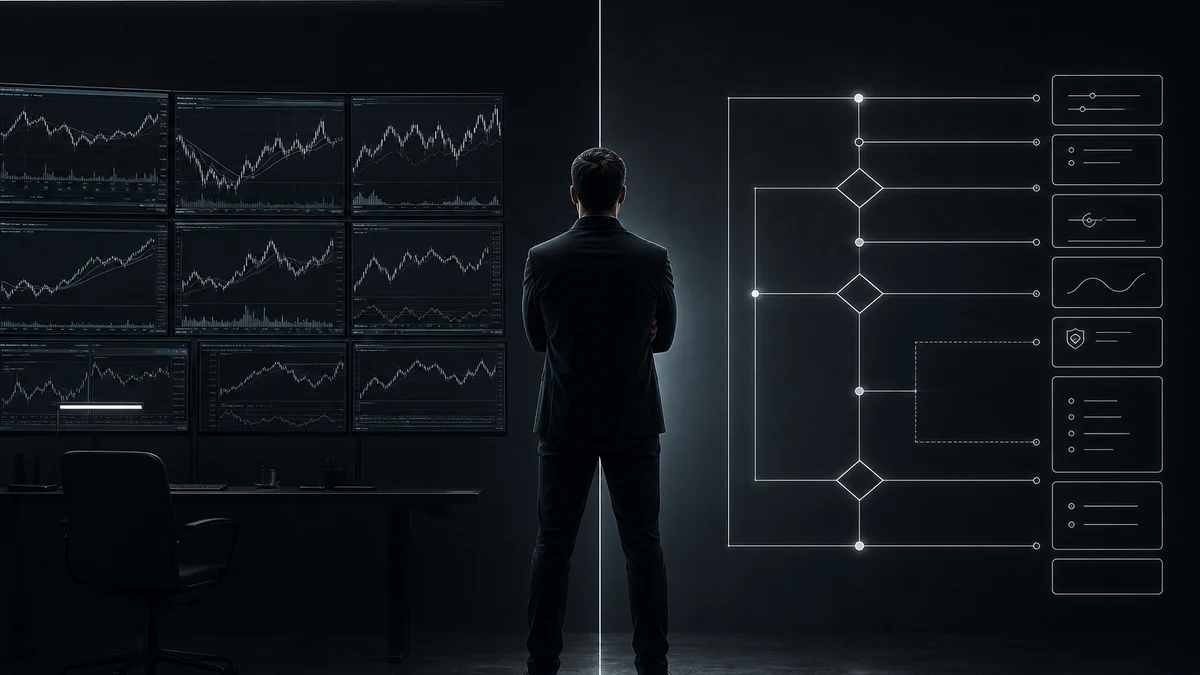
Short answer: I separate automated investing and manual trading because they are different methodological models. In manual trading, much depends on a person's current decision. In automated and algorithmic investing, the focus is on a predefined procedure, risk control, and execution discipline.
My name is Alexey Mokrov. At CRYPTOBOTPRO LLC, we work in automated and algorithmic investing. For me, this is not a pretty label, but a way to think about the market without the theater of emotions: less improvisation, more rules; less "it seems," more predefined behavior.
Manual trading and automated investing are often put into the same box. The mistake is understandable. In both cases, there is a market, assets, entry points, volatility, expectations, news, and the human desire to control everything. But the similarity ends quickly. Manual trading is usually built around a decision here and now. An automated approach is built around a predefined procedure.
This is a fundamental difference. Not a cosmetic one.
Manual trading: the person at the center of every decision
Manual trading as a methodological model relies on a person's constant assessment of the situation. A person watches the market, interprets signals, makes a decision, changes the plan, cancels the decision, and makes a decision again. Sometimes this is called flexibility. Sometimes it is simply fatigue with an open chart.
The manual approach has a strong side: it allows a quick response to new information. But this same feature has a reverse side. The more often a person makes decisions manually, the more room appears for emotional noise.
The market does not have to be polite. It can move sharply, slowly, illogically, against expectations, without explanations, and with explanations after the fact. In such conditions, manual mode can easily turn into a series of reactions. A person stops managing the process and starts chasing their own tension.
The typical problem with manual trading is not that a person "thinks poorly." The problem is deeper: a person thinks under pressure. When there is movement on the screen, the brain wants to close uncertainty immediately. This is where premature actions, violations of one's own plan, and revisions of rules right during a market move appear. Very convenient. And very dangerous for discipline.
Automated investing: procedure before emotion
Automated investing as a model is arranged differently. First, the rules are set. Then the rules are executed. Not the other way around.
In this logic, what matters is not a person's heroism at the monitor, but the quality of the procedure described in advance. What to do in a calm market. What to do during a correction. How to limit risk. How not to turn every movement into a reason for manual intervention. How not to confuse control with panic.
CRYPTOBOTPRO LLC views risk management and a predefined procedure for actions as an important part of the investment approach. This is a key methodological emphasis. Not a mood. Not a slogan. Not a decoration for a presentation. A procedure is needed precisely when the market stops behaving comfortably.
When everything is calm, discipline seems boring. That is the problem. The real value of rules is visible not in a moment of comfort, but in a moment of pressure. When you want to "deviate from the plan just a little." When it seems that you definitely need to intervene right now. When the inner commentator has already written a dramatic scenario and demands action.
Automation does not eliminate uncertainty. It does not make the market convenient. It does not turn a complex environment into a mechanical button. But it does help separate the decision in advance from the moment of emotional overheating.
The main boundary: where the decision is made
To simplify, the difference between the approaches comes down to one question: when is the decision made?
In manual trading, the decision is often made at the moment of a market event. A person sees a movement and decides what to do. In an automated model, a significant part of decisions is transferred into a preliminary procedure. The event happens later, while the rules of behavior have already been described.
This changes the mechanics of management itself. A person stops being the dispatcher of every second. Their task shifts higher: not to guess every market turn, but to design rules, limits, and an order of actions.
This is where the boundary I consider important lies. Manual trading requires constant presence in the moment. Automated investing requires maturity before the moment. And these are not the same thing.
Why discipline is more important than the feeling of control
The market creates an illusion: if you look at the chart more often, you will have more control. In practice, frequent looking does not always equal better management. Sometimes it is simply a way to feed anxiety with fresh candles. Yes, it sounds unpleasant. But it is honest.
Discipline does not begin with a button or a forecast. It begins with answers to boring questions. Which actions are allowed. Which actions are prohibited. What counts as normal market noise. Where the limit of intervention lies. What order is maintained during a correction.
Without a procedure, an investor can easily become hostage to the current mood. Today, they are a strict, systematic person. Tomorrow, the market moves more sharply than usual, and the strict, systematic person suddenly starts negotiating with themselves. Usually this is a bad committee: many emotions, little protocol.
The automated approach is valuable because it forces the rules to be put on the table in advance. Not when it is already too late to think calmly, but before the pressure begins.
Risk management as part of the structure, not an appendix at the end
Risk management is often perceived as a section added after a beautiful idea. First an entry is invented, then somewhere on the side the words "risk control" are added. I consider this sequence weak.
In a normal investment methodology, risk management must be built into the structure from the very beginning. It answers not only the question "what to do if the market moves uncomfortably," but also the more important question: which actions are even allowed within the approach.
A predefined procedure is not needed for appearance. It reduces the dependence of the process on a person's emotional state. It sets boundaries. It helps prevent a system from being replaced by an opinion that appeared under the pressure of the moment.
In this sense, automated investing is closer to an engineering discipline. First design. Then execution. Then control of compliance with the rules. Less romance. But also less circus.
Why I do not mix these models
Mixing manual trading and automated investing creates methodological mush. In words, a person says they have a system. In practice, they intervene every time the market does not look the way they would like. Formally, rules exist. In fact, the rules work only until the first emotional discomfort.
I separate these approaches for precisely this reason. Manual trading can be a separate discipline with its own requirements, skills, and mode of attention. Automated investing requires a different focus: predefined logic, risk control, a procedure, and a willingness not to break the rules at the first sign of tension.
There is no need here to declare one approach "good" and the other "bad." That is a childish level of debate. The adult question sounds different: which mode of management suits a person who does not want to live inside a chart and make every decision under market pressure?
My answer: such a person needs not an imitation of control, but a clear order of actions. Automated and algorithmic investing as a field is built precisely around this idea: less manual fuss, more predefined procedure.
What an investor should understand
Automation does not free anyone from responsibility. It does not remove the need to understand the approach, the risks, and one's own limitations. You cannot hand the process over to rules if the rules themselves have not been understood. You cannot call chaos a system just because there is a program in it.
A mature automated approach begins with sober questions. Which market situations are taken into account. Which limits are set. How behavior during corrections is described. What is prohibited from being done manually. When it is necessary to observe, and when it is truly necessary to review the procedure itself.
The last point is especially important. A procedure should not change because of every piece of market noise. But that does not mean it is carved in stone forever. The difference is that reviewing the rules should take place as a separate management process, not as an emotional reaction to the screen.
Conclusion
Automated investing and manual trading differ not in interface, but in management philosophy. In the manual approach, a person often makes decisions inside market pressure. In the automated model, the center of gravity is shifted to a predefined procedure.
CRYPTOBOTPRO LLC works in automated and algorithmic investing. In this context, risk management and a predefined order of actions are an important part of the investment approach.
For me, this is a normal engineering position: first rules, then action; first boundaries, then the market; first a cool head, then everything else.