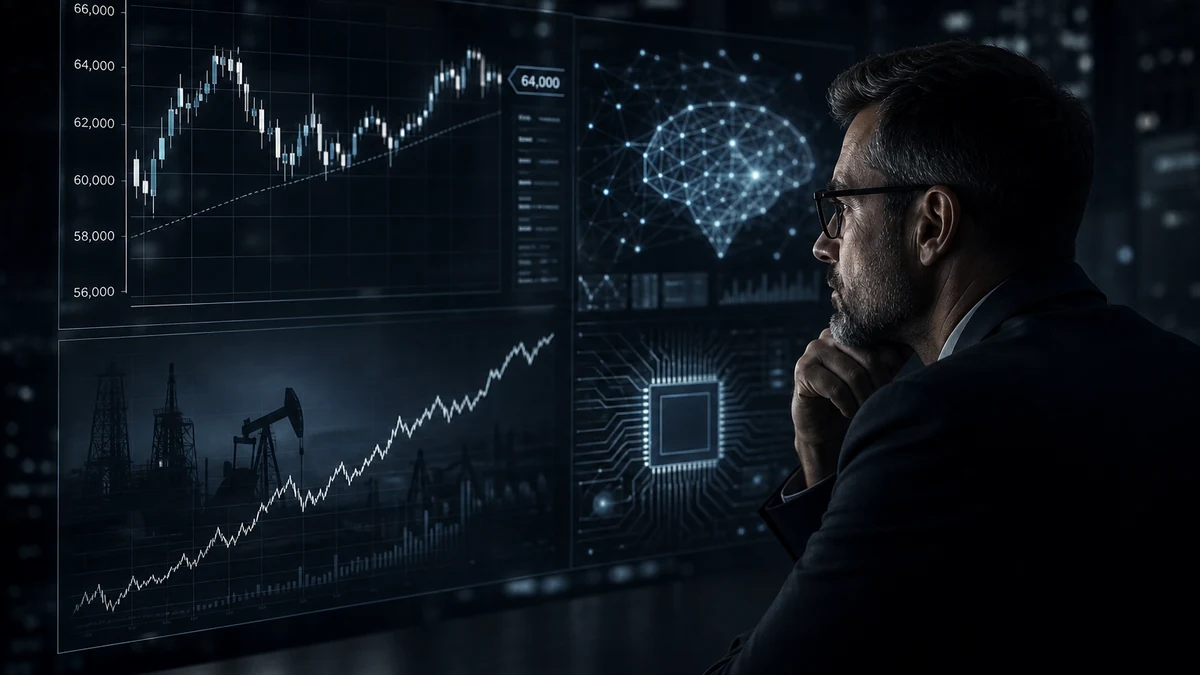
Short answer: Bitcoin is holding near $64,000 not because the market has become calm, but because two forces have temporarily balanced each other. Rising oil intensifies inflation fears and weighs on risk. Pressure on the AI and semiconductor segments hurts technology sentiment, with which Bitcoin has traded in close connection in recent weeks. Until investors see a new macro signal, the market is choosing to pause.
What happened
According to CoinDesk, Bitcoin traded around $64,200 on Monday, almost unchanged for the day and roughly 3% higher for the week. Daily turnover, the publication reported, was about $18 billion. Ether was near $1,860 and was up 5% over seven days, remaining one of the stronger large assets in the source's sample.
Other major coins, according to CoinDesk, moved weakly: XRP held near $1.09, Solana traded around $76, BNB declined toward $565, and dogecoin remained near $0.07. The exception was Hyperliquid's HYPE, which, according to the source, was losing about 10% for the week. CoinDesk does not cite a separate specific catalyst for this move beyond the broader risk-off mode.
The main external irritant came from the oil market. Brent, the source reports, rose almost 4% to $91.42 per barrel, the highest level since June. The reason cited in the article is the expansion of U.S. and Iranian strikes beyond military targets. The market quickly remembered an old unpleasant linkage: expensive oil, higher inflation expectations, and less room for easy monetary policy.
The second factor came from the technology sector. CoinDesk links pressure on semiconductor stocks to the release of Moonshot AI's Kimi K3 model. According to the publication, the Chinese open-weight model took first place in a widely followed coding benchmark, which shocked part of the AI infrastructure market. On Friday, this hit semiconductor stocks, and on Monday the echoes of the sell-off continued in Asia: South Korea's Kospi, the source reports, fell 3.5% after traders returned from the weekend.
Why this matters for the market
The importance of the news is not that Bitcoin crossed another round level. It did not. The importance lies elsewhere: the market again found itself between an inflationary shock and a reassessment of technology optimism. These are two different reasons for a decline in risk appetite, but both work through the same pipe: the cost of capital.
Rising oil does not by itself have to crash the market immediately. But oil affects inflation expectations, especially if the move is linked not to a planned supply adjustment, but to military escalation. If investors believe energy can become sustainably more expensive, they start to assess future central-bank policy more cautiously. Dovish rhetoric quickly becomes less convincing when commodities are surging. The Fed does not have to react to every jump in Brent, but the market reacts in advance. It always likes to pretend it can read the regulator's mind. Sometimes it looks funny, but this is exactly how money moves.
The AI factor works differently. The Kimi K3 release, according to CoinDesk, called into question part of the market narrative around expensive artificial intelligence infrastructure. If a strong Chinese model shows a high result in a coding benchmark, investors begin debating how durable expectations are for demand for chips, data centers and capital expenditures by major technology companies. This is not proof that the AI theme has collapsed. It is a reason to recalculate valuations. And recalculating valuations in an overheated sector rarely happens quietly.
For digital assets, the connection here is objective and direct through the market channel, although the causes are external. In this configuration, Bitcoin is not an isolated coin in a vacuum. It competes for capital with growth stocks, technology themes, dollar liquidity and short-term instruments. When the cost of risk rises, an investor does not ask whether an asset has a beautiful narrative. The investor asks how much pain must be endured for the right to hold the position.
Impact on liquidity and risk appetite
Liquidity in this story did not disappear in one day. But its price became less comfortable. Expensive oil can intensify inflation expectations, and that raises the probability of a tougher stance on rates or at least reduces confidence in future easing. When yields on safe instruments look more attractive, capital becomes less patient with volatile assets.
A separate channel runs through technology stocks. In recent months, many risk assets have lived alongside the AI narrative: expectations of growth in capital expenditures, demand for computing, expansion of data centers and related infrastructure. According to CoinDesk, this is precisely the sector that came under pressure after the Kimi K3 release. If the technology sector loses stability, some investors reduce risk more broadly across the portfolio without analyzing each asset separately.
For Bitcoin and major digital assets, the mechanism looks like this: oil weighs through inflation expectations and rates, while the AI sell-off weighs through growth stocks and an overall decline in risk appetite. Therefore, the connection with the event is strong, but not fundamental in terms of protocols or the network. It is a market connection through capital flows, the margin sensitivity of expectations and the behavior of institutional portfolios.
At the same time, the source indicates that Bitcoin was almost unchanged for the day. This is an important detail. The market did not receive an unambiguous impulse. Some participants see rising oil and want to reduce risk. Others see the absence of new U.S. macro data this week and are not rushing to sell. The result looks like sideways trading, but inside it a reassessment of scenarios is underway.
Why the week became corporate rather than macroeconomic
CoinDesk notes that there are no major U.S. economic data releases this week, so attention is shifting to corporate earnings. The source names Alphabet on Tuesday, Tesla on Wednesday and Intel on Thursday. This is not just an earnings calendar. It is a test of how much the market believes in the continuation of the AI cycle after Friday's hit to the semiconductor segment.
If company reports and comments confirm strong demand for infrastructure, the market may decide that the reaction to Kimi K3 was excessive. If management teams start speaking more cautiously about spending, margins or demand momentum, pressure on technology assets may continue. For Bitcoin, this matters not because it depends directly on Alphabet's or Intel's profits. It matters because large investors often manage a basket of risk, not a set of romantic beliefs.
This is also where the topic of miners comes in; in recent cycles, they have tried to integrate into AI infrastructure and data centers. CoinDesk indicates that the reports should show whether there is a floor under the capital expenditures on which this pivot rests. This is already a closer bridge between the technology sector and the crypto ecosystem. But caution is needed here as well: one report does not cancel a trend, and one strong benchmark does not destroy demand for hardware. The market is simply checking the price of its previous confidence.
Three possible scenarios
- Base-case scenario. Oil remains elevated, but without a new sharp jump, and technology reports do not completely break the AI narrative. In this case, Bitcoin may continue trading in a range, reacting to headlines and Nasdaq movements, but without a strong independent impulse.
- Positive scenario. The geopolitical premium in oil declines, Brent pulls back from its one-month high, and reports from major technology companies confirm steady demand for AI infrastructure. Then the cost of risk may decline, and capital may again start seeking returns in more volatile assets.
- Negative scenario. Military escalation strengthens the rise in oil, inflation expectations return to the center of attention, and technology company reports disappoint the market. Then investors may simultaneously reduce positions in growth stocks and digital assets. In such a scenario, sideways trading quickly turns into a test of liquidity levels below current prices.
What to watch next
First indicator: Brent. Not the number on the screen itself, but the durability of the move. One touch of $91.42 per barrel, which CoinDesk reports, is a signal. A consolidation above recent levels and an expansion of the geopolitical premium would be a different conversation.
Second indicator: the reaction of the bond market and rate expectations. If oil starts feeding into inflation expectations, investors will look at risk more cautiously. If the debt market ignores the oil jump, the pressure may prove short-lived.
Third indicator: the Nasdaq 100 and the semiconductor sector. The source indicates that Nasdaq 100 futures had stabilized at the time of publication and were adding about 0.5%, but the question raised by the Kimi K3 release has not disappeared. Stabilization over one morning is not the same as a restoration of confidence.
Fourth indicator: the reports from Alphabet, Tesla and Intel, which CoinDesk highlights as key events of the week. Strong numbers matter, but comments about capital expenditures, demand for computing and the profitability of AI investments matter even more. The market is not trading past profit now, but confidence in the future cycle.
Fifth indicator: Bitcoin's own behavior against the backdrop of external shocks. If the price holds while the background worsens, that indicates the presence of demand. If any pressure in oil or AI stocks quickly translates into selling, it means the market remains dependent on external liquidity.
Practical takeaway for the investor
The main mistake now is to interpret sideways movement as an absence of risk. When an asset stands still between an oil shock and a reassessment of the AI sector, that is not calm. It is a pause before choosing a direction.
In practice, this means three things. First, position size must be able to withstand a scenario of increased volatility. Second, decisions are better tied not to headlines, but to predefined conditions: risk level, asset allocation, horizon and acceptable drawdown. Third, the investor should separate the investment plan from reactions to noise. News is needed not for panic, but to test a hypothesis.
I see no point in trying to guess what will work first: oil, technology company reports or another AI headline. It is far more useful to have rules of behavior for different scenarios. In the practice of CRYPTOBOTPRO LLC, we proceed precisely from this principle: automated investing on SPOT should rely on capital allocation, limits and actions during corrections, not on heroic guesses in front of a monitor.
Alexey Mokrov's opinion
I look at this situation coldly. Bitcoin near $64,000 is not currently showing strength or weakness in pure form. It is showing waiting. The market is waiting to see which risk becomes dominant: the inflationary one through oil or the technology one through AI stocks.
For me, the conclusion is simple: when external factors conflict, an investor should not become a commentator on every candle. A plan, limits and an understanding that a correction does not ask for permission are needed. Especially when oil, rates, technology stocks and digital assets begin moving with one nervous system.
Educational disclaimer: this material is not an individualized investment recommendation. The digital asset market is volatile, and any decisions require your own assessment of risk, time horizon and financial position.