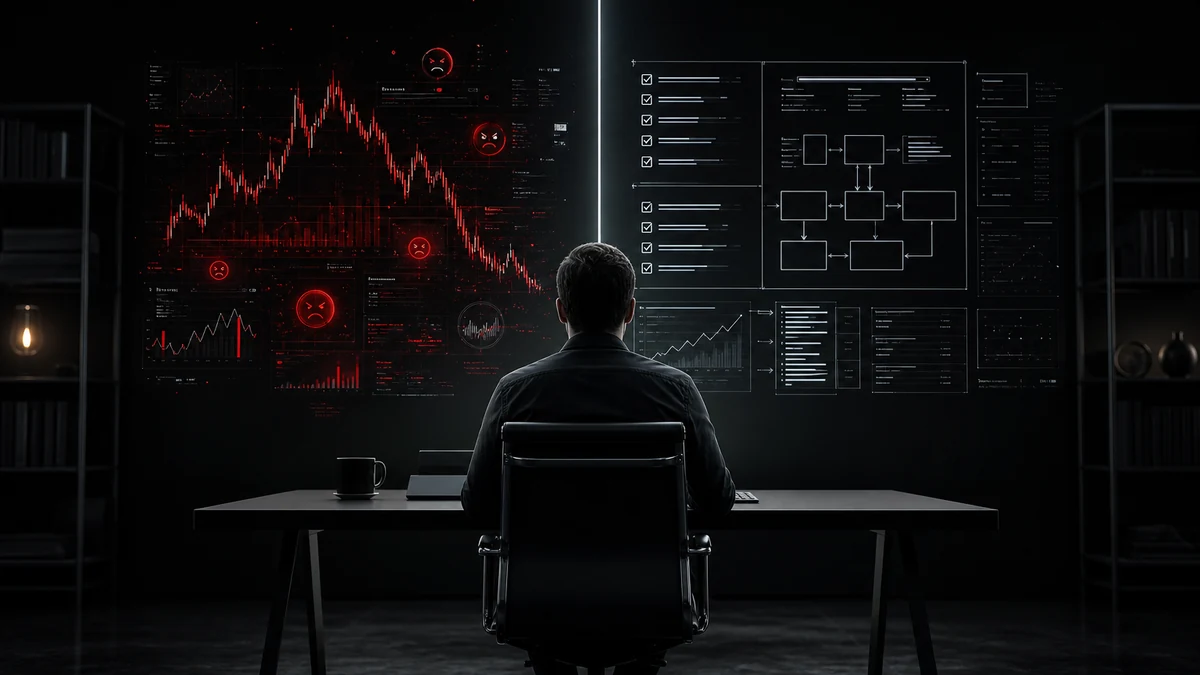
Short answer: CRYPTOBOTPRO LLC separates automated investing and manual trading because they are different methodological models. In one, the center of gravity lies in rules, procedures, and risk control. In the other, much depends on a person’s decisions at a specific moment. Mixing them is convenient only in words. In practice, it quickly turns into chaos.
I approach the market like an engineer. Not like a casino with a nice interface. Not like a place where you have to guess the crowd’s mood every morning. The market is complex, noisy, and regularly tests a person’s discipline. So for me, the question is not who presses buttons louder. The question is how the decision-making process is structured.
CRYPTOBOTPRO LLC works in the field of automated and algorithmic investing. CRYPTOBOTPRO LLC also treats risk management and a predefined procedure for actions as an important part of the investment approach. These are two facts about the company. Everything else in this article I examine as methodology: how an automated approach differs from manual trading and why confusing them is dangerous.
The main difference: where the decision is located
In manual trading, the decision most often belongs to the person in the moment. A person looks at the market, reads the news, assesses the chart, remembers yesterday’s mistake, argues with themselves, and presses a button. Sometimes they act calmly. Sometimes they are tired. Sometimes they are angry. Sometimes they simply want to “win it back.” The market does not cure such states. It amplifies them.
In automated investing, the logic is different. First, the rules are set. Then the process follows those rules. The person does not disappear from the system, but their role shifts. They should not argue with the market every minute. Their task is to define the framework, limits, conditions, and order of actions in advance. This is more boring than heroic trading across three monitors. But boredom is often more useful than adrenaline.
This is where the methodological boundary appears. Manual trading is built around an operational decision. Automated investing is built around a predefined process. This is not a matter of fashion. It is a matter of behavioral architecture.
Why mixing approaches breaks discipline
The most common mistake of a private investor is to take an automated idea and start “improving” it manually. First, enter a little earlier. Then exit a little later. Then cancel the rule because “this is a special case right now.” Then add a piece of news from a chat. Then open the chart at night. Congratulations, there is no automation anymore. What remains is manual mode with a decorative sign saying “system.”
The problem is not that a person thinks. Thinking is necessary. The problem is that unplanned intervention changes the very nature of the approach. If rules can be broken every time anxiety appears, then it is no longer a procedure. It is a mood diary.
I separate these approaches for exactly this reason. Automated investing requires respect for a predefined order. Manual trading allows constant reassessment of the situation. Both approaches have their own internal logic. But if they are mixed without strict boundaries, the investor gets not flexibility but a conflict of commands.
Risk control is more important than a beautiful forecast
The financial market loves people who are too confident in forecasts. Not for long. Then it usually becomes unpleasant.
In my methodology, the first question is not “where will the market go,” but “what do we do if the market goes the wrong way.” This is a mature way to frame the task. A forecast can be careful, intelligent, and visually convincing. But a forecast does not replace a procedure. Especially during corrections, when emotions begin to work faster than the mind.
CRYPTOBOTPRO LLC treats risk management and a predefined procedure for actions as an important part of the investment approach. For me, this is not a presentation ornament. It is the foundation of a normal attitude toward capital. If behavioral boundaries are not defined in advance, then in a stressful phase people will begin inventing them on the run. And on the run, people rarely become more rational.
The value of an automated approach is not that it “knows the future.” It does not have to know it. Its strength lies elsewhere: in the ability to describe acceptable behavior in advance and reduce the influence of impulse. This is not magic. It is discipline transferred into a process.
Manual trading: its strength and its weak point
Manual trading can be intellectually complex. It involves analysis, speed, experience, and observation of context. I am not going to portray the manual approach as primitive. That would be cheap polemics.
But the manual approach has a weak point: it strongly depends on a person’s condition. Fatigue, anxiety, irritation, greed, fear of missing a move, the desire to prove one is right. All of this enters the process not as theory but as ordinary everyday reality. A person can be smart and still make weak decisions in a bad state. Intelligence does not cancel physiology.
Manual trading requires constant concentration. It pulls a person into charts, news, opinions, and arguments. For an entrepreneur or private investor who manages capital while also living an ordinary life, this quickly becomes a separate job. And a job with no weekends inside the head.
Automated investing: not autopilot for the thoughtless
There is another mistake as well: thinking of automation as a “let everything run by itself” button. That is how people reason when they confuse a system with an amulet. Automated investing does not remove responsibility. It does not free a person from understanding risk. It does not make the market obedient.
Automation is useful when it is backed by a clear methodology: which decisions should be formalized, which restrictions are set, which actions are described in advance. If there are no rules, there is nothing to automate. You can automate order. You cannot automate hope.
That is why I separate automated investing and manual trading not for the sake of terminology. Terms by themselves are worth nothing. The separation is needed so as not to deceive oneself. If the approach is automated, it must contain rules and procedures. If the approach is manual, one must honestly acknowledge dependence on the person in the moment.
Why procedures are especially important during corrections
A calm market makes people disciplined only on the outside. The real test begins when the price moves against expectations, the news background becomes nervous, and collective hysteria appears in chats. That is when it becomes clear whether the investor has a system of behavior or only a set of beautiful phrases.
A correction is not only a price movement. It is a psychological test. A person begins looking for confirmation of their fears. They reread opinions. They compare themselves with others. They urgently want to do something because inaction seems like weakness. In reality, extra action is often not control but panic in an expensive suit.
A predefined procedure is needed precisely for such moments. It does not make the market convenient. It makes behavior more manageable. That is a big difference. The market is not obliged to adapt to the investor, but the investor is obliged to understand their own boundaries.
What I consider a mature approach
A mature approach begins with rejecting the illusion of complete control. No one controls the market. One can control only one’s own process: rules, limits, frequency of intervention, attitude toward mistakes, and execution discipline.
For me, automated investing is not a way to look technological. It is a way to remove unnecessary noise from decision-making. Less impulse. More procedure. Less “it seems.” More “this is what is prescribed.” Yes, it does not sound romantic. But the market does not pay for romance. It regularly sends the bill for overconfidence.
In this sense, manual trading and automated investing should not be declared enemies. They should be placed on different shelves. Each approach has its own requirements, its own discipline, and its own burden on the person. Problems begin when an investor adopts the language of a system but keeps the habits of an impulsive manual mode.
The position of CRYPTOBOTPRO LLC
The position is simple: CRYPTOBOTPRO LLC works in the field of automated and algorithmic investing. In this context, risk management and a predefined procedure for actions are regarded as an important part of the investment approach.
I see no point in decorating this with grand words. A methodology should be verifiable by its internal discipline: whether there are rules, whether there are boundaries, whether there is an understanding of behavior in a difficult market phase. Without this, any talk about an investment approach turns into theater of confidence.
Automated investing and manual trading are separated not because one term is more beautiful than the other. They are separated because they answer the key question differently: who makes the decision under pressure — a predefined process or a person influenced by their current state.
My choice as an engineer-strategist is to build thinking around process, discipline, and risk control. A cool head is boring only to those who have not yet seen how expensive a hot one can be.
This material is for informational purposes and is not an individualized investment recommendation.