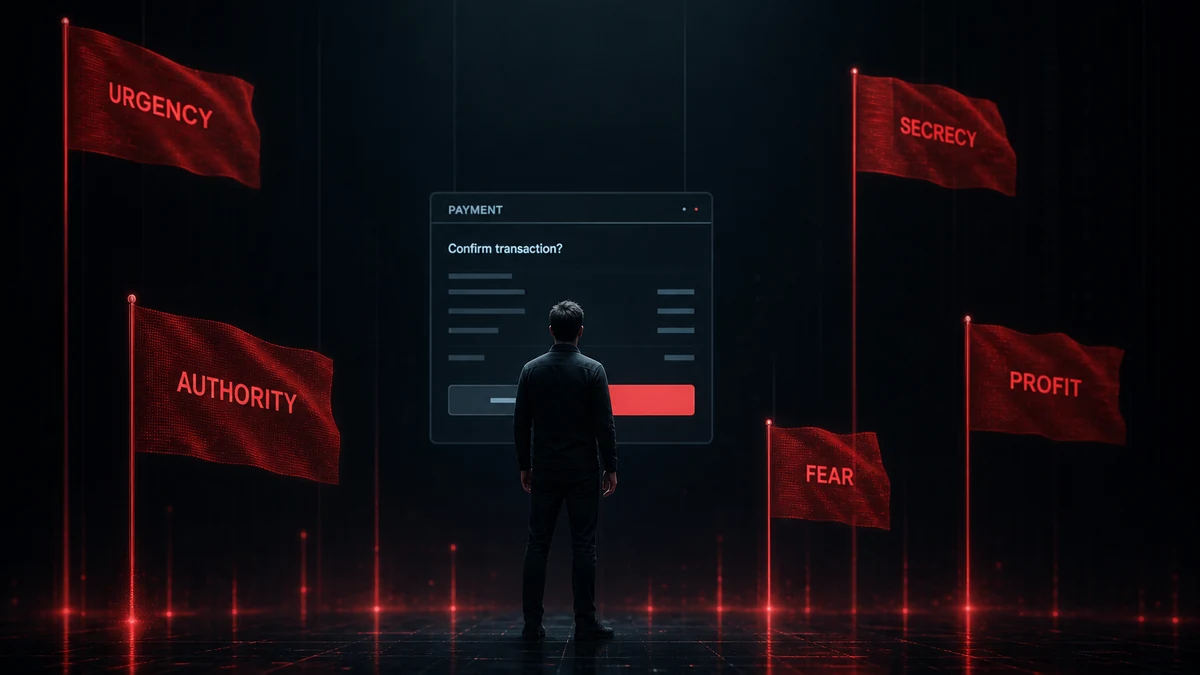
A dangerous transfer often begins not with bank details, but with pressure. You are rushed, frightened, praised for a “quick decision,” forbidden to seek advice, or handed someone else’s authority. If a decision cannot be calmly checked, postponed, and discussed, it is no longer analysis. It is a script for controlling you.
I am Alexey Mokrov. In this article, I have collected a library of red flags that you can forward to parents, partners, accounting, an assistant, or yourself for moments of fatigue. Because in reality, people lose money not only because of greed. More often, they fall into someone else’s pace, someone else’s anxiety, and someone else’s story.
How to use this library
You do not need to prove that the person in front of you is a scammer. That is a trap. While you are trying to “figure it out completely,” you are still being controlled.
The task is simpler: notice signs of pressure before transferring funds. One red flag is not yet a verdict. Two red flags require a pause. Three red flags mean: stop, transfer nothing, leave the dialogue, and check the situation through an independent channel.
The main rule: a normal financial transaction can withstand a pause, a question, and verification. A fraudulent script usually falls apart precisely on these three things. That is why a scammer needs speed. They do not need your head. They need your reaction.
Flag 1. Urgency: “it has to be right now”
Typical phrases: “five minutes left,” “the window is about to close,” “if you do not confirm, it will be too late,” “act immediately,” “do not hang up.”
What is happening: your time for doubt is being reduced. Urgency switches off the usual verification process: reread, call, compare data, ask another person. The decision becomes a reflex.
Red flag: the person on the other side is not merely stating a deadline, but forbidding you to pause. Especially if they keep you on a call, in a chat, or on video.
What to do: say out loud: “I do not make financial decisions in urgent mode.” After that, end the contact. Do not argue. Do not explain. Do not prove your reasonableness to a stranger. This is not a court; it is a sanitary zone.
Flag 2. Easy gain: “you are risking almost nothing”
Typical phrases: “the income has already been credited,” “you only need to pay the fee,” “the spot is almost yours,” “earnings are guaranteed,” “join now, and later you will regret not entering earlier.”
What is happening: you are being sold not a deal, but the feeling of a missed opportunity. A person starts thinking not about verification, but about how not to end up looking foolish on the sidelines. An old bait in new packaging. It works precisely because it flatters.
Red flag: before receiving the benefit, you urgently need to transfer something: a tax, a fee, insurance, a verification payment, “account activation.” If the money is supposedly already yours, but to access it you need to send new money, stop.
What to do: ask one dry question: “Why is the fee not deducted from the amount you call mine?” If a long explanation with pressure begins, that is not an answer. It is a smokescreen.
Flag 3. Authority: “the specialist said so”
Typical phrases: “I am from security,” “this is an instruction from management,” “your manager confirmed it,” “the system requires it,” “the lawyer has already checked it,” “the finance department is waiting.”
What is happening: you are being offered to replace your own verification with someone else’s status. The authority may be real, fake, or simply named out loud. For pressure, that is enough. A person hears a title and begins to obey the role.
Red flag: the authority demands a nonstandard action: transfer money, install an application, state a code, follow a link, change payment details, or not tell colleagues or relatives.
What to do: verify the channel, not the title. End the conversation and independently contact the organization using a known number, website address, or internal contact. Not through a link from the message. Not using a number dictated to you. Yes, it is boring. But money likes boredom too.
Flag 4. Request from an acquaintance: “it’s me, help urgently”
Typical phrases: “I cannot talk,” “transfer it urgently,” “I will explain later,” “do not write to anyone,” “I have a problem,” “my card is not working,” “right now it is a matter of life and death.”
What is happening: the pressure is built not on gain, but on care. This is especially dangerous for families and businesses. Good people help quickly. That is exactly what scammers count on.
Red flag: an acquaintance changes their communication style, asks for money to new details, refuses a voice or video call, asks to keep it secret, and pressures your sense of guilt.
What to do: introduce a family and work verification phrase. Simple, agreed in advance. For example: “What was our first cat’s name?” or any other question that cannot be found from public profiles. Step two: a call through the old contact that was already in the phone. Not through a new number from the message.
Flag 5. Fear of losing access: “your account will be blocked”
Typical phrases: “a suspicious transaction is in progress,” “you need to save the funds,” “create a safe account,” “transfer the assets to a reserve address,” “everything will be frozen now,” “you will be to blame yourself.”
What is happening: you are shown a threat and immediately offered “the only way out.” This is a classic pairing: frighten, narrow the choice, give instructions. In such a scheme, a person often does not ask the main question: why does saving money require transferring money to a stranger?
Red flag: you are asked to move funds “for protection.” Especially if the operation goes to a new account, a new address, an unknown card, or under the control of the other person.
What to do: use the cold-channel rule. Any threat of blocking is checked only through an official login, a known application, a previously saved contact, or a personal account that you opened yourself. Not through a link. Not by dictation. Not during someone else’s call.
Flag 6. Secrecy: “do not tell anyone”
Typical phrases: “this is confidential,” “if you tell anyone, you will disrupt the operation,” “relatives will not understand,” “employees must not know,” “we are investigating an internal company leak,” “do not discuss this with the accountant.”
What is happening: you are being isolated. While a person is alone, they are easier to control. A third party often destroys the script in one minute with a simple question: “Why does it need to be done exactly this way?” That is why the scammer forbids advice in advance.
Red flag: the secrecy concerns not commercial information, but the very fact of the transfer, change of details, installation of an application, or sharing of codes.
What to do: introduce a rule: any request for a secret transfer is automatically considered suspicious. Not “possibly suspicious.” Automatically. If the operation is legitimate, it will survive an internal check.
Flag 7. Ban on a third party: “you are an adult, decide for yourself”
Typical phrases: “there is no need to involve anyone,” “what, do you not trust us?” “the decision is yours, but there is no time,” “consultants only get in the way,” “if you ask someone, you will lose the chance.”
What is happening: you are simultaneously given the illusion of independence and deprived of the tool of independence. The paradox is elegant. The essence is dirty. An independent decision is not afraid of a second opinion.
Red flag: the other person is irritated not by refusal, but by your wish to verify. This is an important detail. An honest party may be unhappy with a delay. A manipulator fears verification.
What to do: appoint in advance a “control person” for financial pauses: a relative, partner, lawyer, CFO, or accountant. Their task is not to decide for you, but to stop someone else’s script and ask five uncomfortable questions.
Flag 8. Technical fog: “just follow the instructions”
Typical phrases: “do not get into the details, this is a technical procedure,” “do not close the screen,” “install the support application,” “enter the code to cancel the transaction,” “turn on screen sharing.”
What is happening: complexity is used as a screen. You are overloaded with terms, windows, codes, notifications. When a person stops understanding what exactly they are confirming, they begin to obey the one who speaks confidently.
Red flag: the action looks technical, but gives access to money, an account, a device, email, a messenger, or confirmation codes.
What to do: adopt a strict rule: codes, remote access, screen sharing, and application installation are never performed upon an incoming request. Even if the voice on the phone sounds very businesslike. Especially if it sounds very businesslike.
Pause protocol before a transfer
Now practice. Not a philosophy of security, but a short procedure.
- Stop the contact. End the call, close the chat, do not follow links. While the contact continues, the pressure continues.
- Name the type of pressure. Urgency, gain, authority, acquaintance, fear of access loss, secrecy, ban on advice, technical fog. Naming restores control.
- Check the channel. Independently open the official website, application, old contact, or internal directory. Do not use data from the current message.
- Involve the control person. At least one external view before any irreversible transfer.
- Write down the decision. What you are being asked to do, where to transfer, who is asking, why it is urgent, how it was verified. If it is embarrassing to write down, then all the more reason not to transfer.
- Postpone the action. A pause does not ruin a normal operation. But it ruins a fraudulent script very well.
For a family, this protocol can be printed and hung next to the desk. For a business, add it to the regulations: changes of payment details, urgent payments, refunds, fees, account access, and nonstandard requests from management go only through independent confirmation.
Phrases worth learning
Under pressure, a person often becomes lost and starts justifying themselves. Do not. Keep ready-made wording.
- “I do not make financial decisions during an incoming call.”
- “I will check this through an independent channel.”
- “I do not transfer money in urgent mode.”
- “I do not share codes and do not enable screen sharing.”
- “Any secrecy around a transfer is a red flag for me.”
- “If the operation is normal, it will withstand a pause.”
These phrases sound dry. That is how they should sound. A manipulator needs an emotional scene. You give a procedure. Boring, unpleasant, effective.
Where the line lies between caution and paranoia
Caution checks the procedure. Paranoia suspects everyone indiscriminately. The difference is simple.
If you say, “I trust no one,” that is not a system. That is fatigue. If you say, “Any transfer above the everyday level goes through a pause, channel verification, and a second confirmation,” that is already order.
In my work at CRYPTOBOTPRO LLC, I constantly return to one principle: money should move according to rules, not impulse. In the company’s practice, this is especially important because automated investing on SPOT is built around discipline, capital allocation, and reducing manual emotional decisions. In protection against fraud, the logic is the same: first the procedure, then the action.
Final list of red flags
- You are being rushed and not allowed to pause.
- Easy gain is promised, but a payment is demanded first.
- A position, department, management, or the “system” is cited instead of normal verification.
- Someone writes in the name of an acquaintance, but avoids voice confirmation.
- You are frightened with blocking, loss of access, or liability.
- You are asked to keep the transfer secret.
- You are forbidden to consult family, a partner, an accountant, or a lawyer.
- You are forced to perform technical actions whose meaning you do not control.
The independence of a decision is preserved not by strength of character. Character can fail on a bad day. Independence is preserved by procedure: stop, name the pressure, independent verification, second opinion, pause.
If someone demands money faster than you can think, that is already the answer. Do not transfer. First, regain your right to decide.