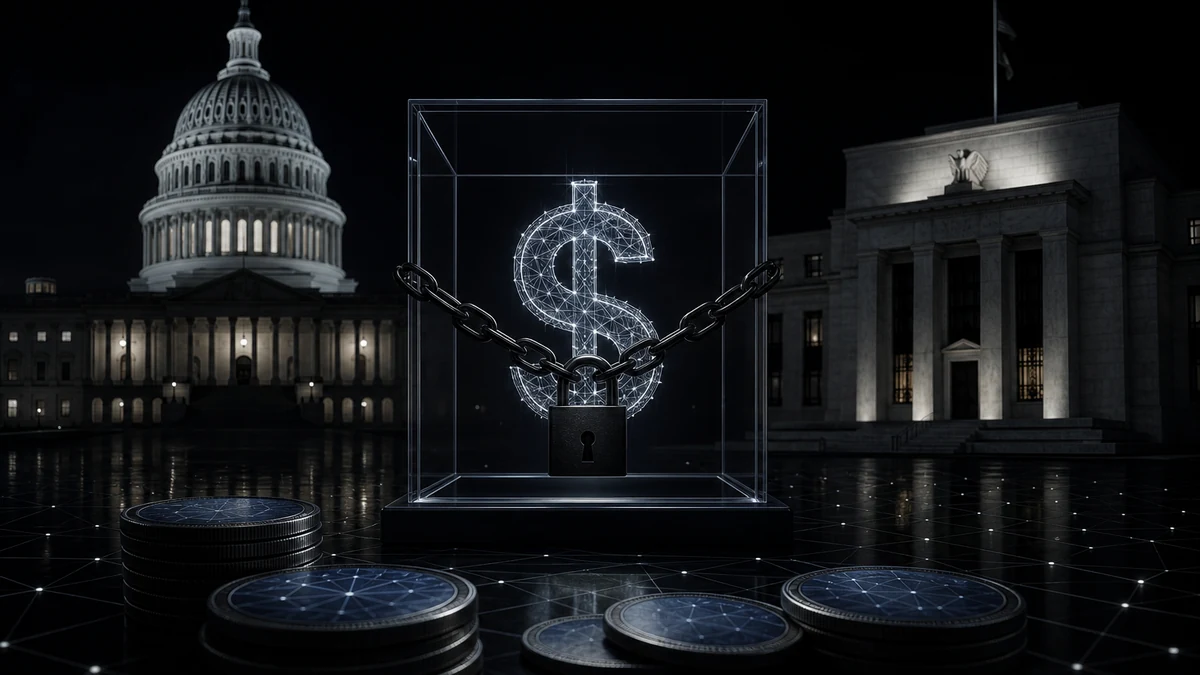
Short answer: according to CoinDesk, a temporary four-year ban on the Federal Reserve issuing a digital dollar is coming into force in the US alongside the housing affordability law. For the market, this matters not because the Fed was already preparing a CBDC for launch. Something else is more important: Congress is drawing a political line between state digital money and private stablecoins, and that line affects investor expectations, the cost of regulatory risk and the future architecture of dollar liquidity.
What happened
CoinDesk reports that the US housing affordability bill is set to become law at the first moment of Saturday, despite President Donald Trump refusing to sign the document. According to the outlet's account, the reason is a constitutional procedure: if a bill approved by Congress reaches the president and is not signed within the established period and is not formally vetoed, it becomes law after a ten-day window.
Inside this housing law is a provision not directly related to housing: a temporary restriction on a US central bank digital currency. According to CoinDesk, for four years the Federal Reserve will not be able to issue its own digital dollar. The restriction, the outlet writes, expires at the end of 2030.
It is important not to confuse the fact with the political packaging. The fact stated by the source: the ban blocks the Fed's ability to issue a CBDC for the duration of the rule. The political assessment of Republican lawmakers reflected by CoinDesk: they viewed a digital dollar as a potential tool of excessive government surveillance. A separate fact from the article: there has not yet been a serious practical attempt to launch a CBDC in the US, and the Fed itself was not moving toward the immediate issuance of such an instrument.
According to the outlet, Trump refused to sign the housing law in protest over the lack of progress on another bill related to verifying voters' citizenship and identity. But no formal veto followed. Therefore, the political demarche did not stop the document from taking effect. Markets love drama, but the law sometimes works boringly. And it is precisely this boring procedure that changes the rules of the game here.
Why this matters for the market
At first glance, the event looks technical: an instrument was banned even though it was not on the launchpad anyway. But markets react not only to what is happening today. They assess the trajectory of rules for years ahead.
A CBDC in the US would not simply be a new payment app. It is a question of who controls the digital dollar layer: the state through the central bank, or the private sector through banks, payment companies and stablecoin issuers. According to CoinDesk, the crypto industry had long opposed an American CBDC precisely because of the risk of competition with private stablecoins. Now that competition is temporarily restricted by law.
For an investor, the main mechanism here is regulatory. When the state shows that it will not launch its own digital dollar at least during the specified period, one type of strategic uncertainty decreases for private projects. This is not a guarantee that their business will grow. It is a reduction in one specific scenario risk: the risk that the central bank enters the same market with an instrument that has maximum legal force, political support and built-in trust in the dollar.
There is also a downside. A CBDC ban does not mean stablecoins automatically receive ideal conditions. Private dollar tokens still depend on reserves, banking access, disclosure rules, supervision, sanctions regimes and regulators' attitudes toward issuers. If the state is not building its own digital dollar, it may regulate the private market more actively. Nature abhors a vacuum. Especially in Washington.
Impact on liquidity and risk appetite
This decision does not create an immediate monetary impulse. The CBDC ban does not change the Fed rate, does not increase the central bank's balance sheet, does not launch an asset purchase program and does not distribute liquidity to market participants. Therefore, linking the rule to an instant rise in risk appetite would be a stretch.
But the event affects another variable: the cost of uncertainty. In financial assets, regulatory risk often works like an invisible discount. The harder it is to understand which rules will apply in two or three years, the higher the required risk premium. The temporary ban on the digital dollar does not remove the entire discount, but it narrows one corridor of uncertainty.
For stablecoins, the mechanism is more direct. If the Fed cannot issue a competing digital dollar, private issuers get time to strengthen infrastructure, expand use and adapt to future regulation. At the same time, an investor should remember: time is not protection. In four years, Congress, the administration, the composition of regulators and the priorities of financial policy may change.
For the crypto market, the connection is direct, but not a straightforward price connection. The news relates to crypto regulation and stablecoin competition with a potential CBDC. It may support the expectation sector around private dollar tokens and settlement infrastructure, but by itself it does not have to move the prices of Bitcoin, Ethereum or altcoins. If the market begins to react, one should watch not slogans, but capital flows, stablecoin liquidity and the tone of further bills.
For inflation expectations, the effect is weak. A CBDC as a settlement technology is not a printing press. Inflation is shaped by monetary policy, fiscal spending, lending, production constraints and household expectations. The digital form of the dollar could change the speed and transparency of settlements, but it does not replace the Fed's decisions on rates and the balance sheet.
The objective connection to the crypto market
The connection here is direct. Not indirect through the dollar, not decorative through the word “digital,” but specifically direct: this is about CBDC, stablecoins and crypto regulation. According to CoinDesk, the restriction was supported by politicians who opposed the digital dollar, and the crypto industry had long perceived a CBDC as a threat to private stablecoins.
At the same time, the strength of the connection is medium, not maximum. Why not maximum? Because the source separately emphasizes that the Fed was not in the process of an actual digital dollar launch, and previous central bank leaders had spoken about the need for White House support and Congressional authorization. In other words, the ban hits not an already operating project, but a potential scenario.
The market may overestimate this event if it sees only the headline. A CBDC ban is not a complete victory for private issuers. It means that in the nearest political cycle, a state competitor in this form becomes less likely. Everything else remains a subject of struggle: reserve rules, issuer status, access to the banking system, user requirements and transaction control.
Three possible scenarios
- Base-case scenario. The restriction acts as a political stop signal for the digital dollar, but does not cause an immediate market revaluation. The Fed was not close to launching a CBDC anyway, so the main effect appears in stablecoin regulation and in the reduction of one long-term risk for private dollar settlement infrastructure.
- Positive scenario. The ban becomes part of a more consistent legal framework for digital assets. If Congress advances clear market rules, including the discussed Digital Asset Market Clarity Act, investors will face less gray area. This could reduce the regulatory discount and improve conditions for institutional participation.
- Negative scenario. The political conflict around the housing law spills over into other initiatives. CoinDesk already indicates that Trump's refusal to sign the document raised questions about the fate of the Digital Asset Market Clarity Act if Congress manages to pass it in the summer. In this scenario, the market receives not clarity, but another demonstration that even agreed decisions can get stuck in political bargaining.
What to monitor next
First: the further fate of the Digital Asset Market Clarity Act. The source links the current situation to the question of whether a similar political conflict could affect this bill. For the market, what matters is not only the wording of one ban, but the United States' ability to adopt a coherent framework for digital assets.
Second: the Fed's rhetoric. Even with a ban on issuing a CBDC, the central bank can discuss payment infrastructure, bank reserves, settlements and stablecoin risks. The tone of these discussions will show whether the Fed sees private digital dollars as a useful market layer or as a source of systemic risk.
Third: the reaction of stablecoin issuers and banks. If the private sector sees a window of opportunity, this should show up not in press releases with fanfare, but in partnerships, reserve disclosures, improved compliance and growth in real usage. Pretty statements do not protect capital.
Fourth: the political cycle. The restriction lasts until the end of 2030, but its practical value depends on the composition of Congress, the position of the White House and regulators' willingness to work with private infrastructure. A law can set the direction, but politics determines the speed.
Practical takeaway for investors
This event should be considered a regulatory factor, not a trading signal. An investor does not need to turn the CBDC ban into a reason to urgently change a portfolio. It is much more reasonable to update the risk map: which assets depend on stablecoins, which projects are sensitive to US regulation, where liquidity is based on expectations, and where there is real demand.
In capital management, I would separate three levels of response. First level: do not make sharp moves on a headline. Second: monitor legislative follow-ups, especially around the structure of the digital asset market. Third: keep risk limits, because regulatory clarity can improve conditions, but it does not cancel volatility.
For me, the working principle is simple: news provides context, decisions are made by the risk management system. Spot exposure only, clear limits, pre-defined rules of behavior during corrections. No leverage and no attempt to play the prophet at the terminal.
Alexey Mokrov's opinion
I consider this news important not because of the digital dollar itself. It was not going to be launched tomorrow morning over coffee anyway. Something else matters: the US is once again showing that the architecture of money is becoming a political field. Who issues the digital dollar instrument, who stores the data, who controls access, who receives the margin from settlements. That is where the real conflict is.
It is easy for a retail investor to fall into a trap here. They see the word CBDC, see a ban, and conclude, “that's it, the private market has won.” No. Only one temporary scenario has won. Regulatory risk has not disappeared. It has simply moved to other offices and other bills.
My conclusion is cold: the event improves predictability for private stablecoins, but it does not create an automatic investment idea. Strong decisions are born not from excitement over a headline, but from controlling position size, understanding liquidity and being ready for a scenario in which the market celebrates first and then remembers the risk. That happens to it. Often.