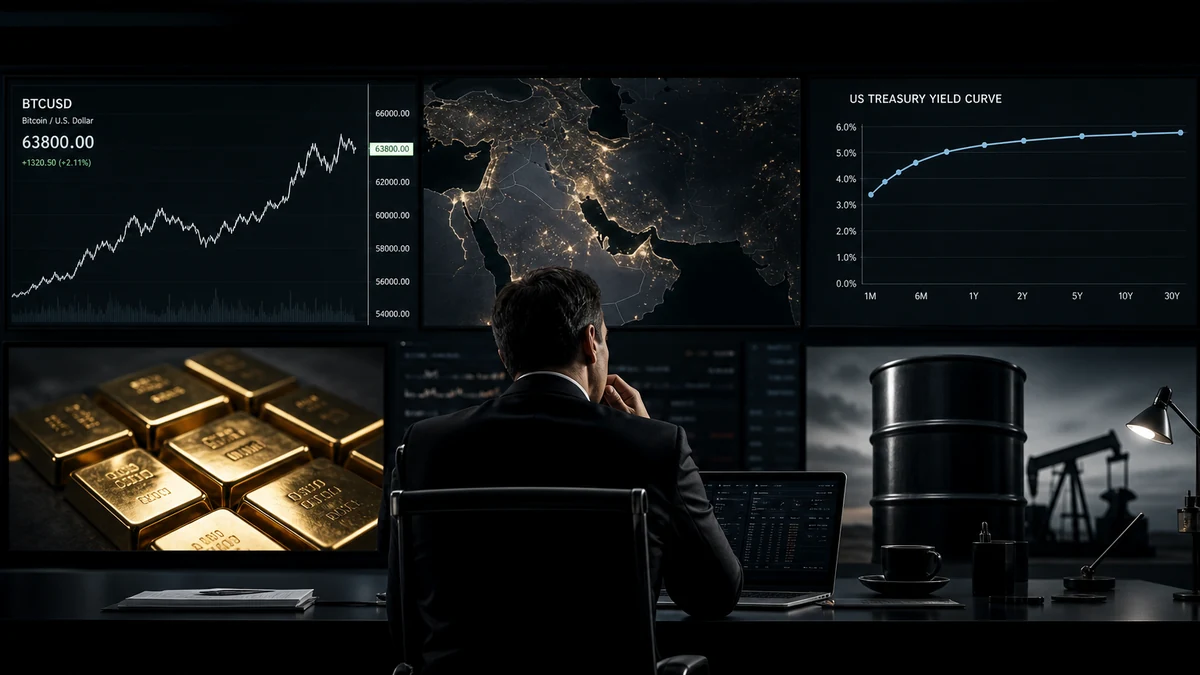
Short answer: according to CoinDesk, Bitcoin held near $63,800 after the fourth round of U.S. strikes on Iran, while oil, gold, equities and bonds moved sharply. This matters not because war risk has disappeared, but because crypto showed a different sensitivity in this episode: it reacted less to geopolitics and remained more closely tied to dollar liquidity, rate expectations and the technology cycle.
What happened
According to CoinDesk, Bitcoin traded near $63,800 on Monday, down roughly 0.3% over 24 hours and still about 2% higher on the week. This followed the fourth round of U.S. strikes on Iran in a week. The source said traditional markets reacted much more sharply: spot gold fell toward $4,050 an ounce, Brent crude rose above $79 a barrel, U.S. Treasuries declined across the yield curve, and the MSCI Asia Pacific index lost about 1.6%.
According to the source, U.S. Central Command said the strikes were a response to an attack on a container ship. Separate uncertainty emerged around the Strait of Hormuz. Iran, as described by CoinDesk, said the waterway would close “until further notice,” while the U.S. denied that. It is important not to overdramatize: the provided material does not establish that the strait was closed. The fact is different: uncertainty around a route through which a significant share of seaborne oil trade normally passes was immediately priced in.
The crypto-market reaction was muted. CoinDesk wrote that Ether was around $1,800 and little changed on the day, Solana remained weaker over the weekly horizon, XRP held near $1.09, and dogecoin was near $0.07. This does not mean risk for digital assets has disappeared. It means that in this specific episode, the market did not broadly sell cryptoassets simply because of the war headline.
Why this matters for markets
Military escalation in the Persian Gulf region usually matters for markets through three channels: oil, inflation expectations and the cost of money. If traders start pricing the risk of supply disruption, oil rises. If oil stays higher, inflation expectations may increase. If inflation looks stickier, it becomes harder for a central bank to ease policy quickly. The chain is simple. Unpleasant. No mystery.
CoinDesk linked traditional-market moves to exactly this concern: a wider conflict could keep oil elevated and force the Federal Reserve to keep rates higher for longer. The article also said minutes from the Fed’s June meeting showed that a few policymakers saw a case for raising rates before backing a hold. That is not a promise of a rate hike. It is a signal that the market has a reason to watch inflation risks closely.
Gold can behave differently in this setup than beginner textbooks might suggest. Formally, gold is considered a defensive asset. But if the market is also raising expectations for real yields, a non-yielding metal becomes less attractive. Bonds come under pressure for the same reason: higher yields mean lower prices for already issued securities. As a result, war risk can hit both defensive and risky assets at the same time. It looks elegant only in presentations. In a portfolio, it feels rougher.
Impact on liquidity and risk appetite
The key mechanism here is not the strike headline itself, but how it changes investors’ liquidity calculations. Higher oil raises inflation risk. Inflation risk raises the probability of tighter monetary policy. Tight policy increases the price of dollars and the cost of funding. When money becomes more expensive, investors are usually less willing to pay for distant growth expectations, whether in technology stocks, venture-style stories or highly volatile assets.
The reaction does not have to be immediate or linear. One headline does not equal a new macro regime. Markets first check whether there is a physical supply disruption, a sustained oil move, confirmation from central banks and a repricing of rates in the bond market. If all those elements align, risk appetite shrinks. If the conflict remains localized and oil quickly falls back, the selloff may prove brief.
For cryptocurrencies, the connection in this episode is direct as a market fact, but the mechanism remains macroeconomic: Bitcoin and major tokens did not fall in sync with oil, gold and bonds because investors did not reprice expectations for digital assets as sharply in the moment. In CoinDesk’s assessment, Bitcoin is now taking its direction more from dollar liquidity and the chip-linked technology-stock cycle than from war headlines themselves. I would call this not immunity, but a change in the main risk sensor.
Why Bitcoin did not follow traditional markets
The most interesting fact in the story is that Bitcoin effectively sat through the event in a narrow range. In the past, similar Middle East headlines often triggered a quick selloff. This time, according to CoinDesk, that did not happen even after a weekend of strikes, Monday pressure across traditional assets and a more hawkish repricing of Fed expectations.
There are several possible explanations. First: the market no longer treats every geopolitical flare-up as an automatic signal to sell everything volatile. After several years of institutionalization, ETF flows and macro orientation, Bitcoin is more often assessed through liquidity and dollar conditions, not only through news-driven stress.
Second: participants may have been waiting for confirmation that the oil shock would prove lasting. A sharp jump in Brent is important in itself, but long-term asset repricing requires more: confirmed supply disruptions, rising inflation expectations, a change in Fed rhetoric and a sustained move in yields. Without that, selling Bitcoin purely because of a headline means trading on reflex, and reflexes in markets are often expensive.
Third: some capital may have been focused on the technology cycle. CoinDesk separately highlighted the Korean stock market and the sharp drop in SK Hynix shares in Seoul after a strong move in the company’s U.S.-listed shares in the previous session. The source linked this to the chip trade that had previously helped support Bitcoin’s rally, yet even the reversal in that segment did not trigger a major crypto-market move on Monday. It shows a strange but useful point: the market does not have to react to every stimulus at once.
Three possible scenarios
- Base scenario. The conflict remains a source of oil premium but does not become a confirmed, prolonged supply disruption. In that case, markets will continue watching yields, the dollar and Fed comments. For Bitcoin, the key issue becomes not the strikes themselves, but whether a tighter rate path becomes entrenched. Range-bound trading may persist until there is a new strong liquidity signal.
- Positive scenario. Uncertainty around the Strait of Hormuz eases, oil pulls back, and the bond market stops pricing an additional inflation premium. Pressure on risky assets then weakens. In this scenario, crypto could receive support not from geopolitics, but from a return of risk appetite and reduced fear of high rates lasting longer.
- Negative scenario. Escalation broadens, oil prices stay elevated, bond yields continue rising, and the Fed has less room to ease. In that case, Bitcoin’s calm reaction today may turn out to be a pause, not resilience. If liquidity begins to tighten in practice, volatile assets rarely stay aside for long.
What to watch next
First indicator: Brent crude and news around the Strait of Hormuz. What matters is not a one-off spike, but price persistence and confirmation of logistical problems. Second indicator: U.S. Treasury yields, especially the short end of the curve. If the two-year yield continues to rise, the market will read that as a tighter rate path.
Third indicator: Fed rhetoric. Investors need to watch not only final decisions, but also language about inflation risks, energy prices and the balance between growth and price stability. Fourth indicator: dollar liquidity and technology-stock performance, especially companies linked to the chip cycle. According to CoinDesk, this channel may now be more important for Bitcoin than the war news flow itself.
Fifth indicator: the crypto market’s own behavior during pressure episodes. If Bitcoin keeps holding its range while yields rise, that says one thing about market quality. If it starts falling faster alongside technology stocks and a stronger dollar, that is a different regime. Do not argue with the regime. Recognize it.
Practical takeaway for investors
The main takeaway: every geopolitical headline should not become a trading order. War risk matters, but what matters for a portfolio is what it turns into: an oil shock, higher inflation expectations, rising yields, a stronger dollar or outflows from risky assets. Until that chain is confirmed by markets, a headline reaction is often noise.
For a private investor, it is more useful to have predefined limits, allocation rules and correction scenarios. Especially in the spot market, where there is no need to amplify a mistake with leverage. In the practice of CRYPTOBOTPRO LLC, we start from the view that automated investing should help maintain discipline in capital allocation and entry points, not replace risk control with hope for a lucky forecast.
This is not personalized investment advice. The event shows only one thing: the market has become more complex than the formula “war means sell risk.” Now it is necessary to watch the mechanism of risk transmission. Those who trade the headline pay for emotion. Those who track liquidity, rates and flows at least understand what they are paying for.
Alexey Mokrov’s view
I do not see Bitcoin’s reaction as a reason for euphoria. Market calm is not the same as protection from a drawdown. But I do see an important shift: participants are no longer automatically selling cryptoassets on every Middle East headline. That is market maturation, even if it remains nervous.
For me, the key question now is not “will war move Bitcoin,” but “which channel becomes dominant: oil, rates, the dollar or technology capital.” The answer will appear not in expert comments, but in prices. That is why a cool head is more useful here than a forecast. The market does not have to be logical every minute. An investor must not break their own plan because of one headline.